


Bitcoin traded between $76,000 and $82,000 during the week of September 7 to September 13. Market mechanics responded to the jump in oil prices, rising sovereign debt yields, and shifts in spot exchange-traded fund capital. Technical barriers rejected price advances near $80,000. Capital rotation, corporate strategy adjustments, and sidechain security failures defined the last week in the market.
The Macroeconomic Squeeze
Inflation data from the Bureau of Labor Statistics established a restrictive environment for risk assets. Wholesale and consumer price index prints exceeded baseline forecasts.
Why it matters: Elevated inflation metrics alter monetary policy expectations. Federal funds futures adjusted to price an 85.4 percent probability of an interest rate hike at the September 16 Federal Open Market Committee meeting. The target range sits at 3.50 percent to 3.75 percent. An increase places the policy rate at 3.75 percent to 4.00 percent.
By the numbers:
Headline Consumer Price Index (August): Increased 0.4 percent month-over-month. The twelve-month reading held at 3.4 percent.
Core Consumer Price Index (August): Excludes food and energy. Increased 0.3 percent month-over-month, beating the 0.2 percent forecast. Annual core printed at 2.4 percent.
Energy Component: Gasoline prices climbed 3.9 percent. Energy advanced 2.1 percent month-over-month and 16.3 percent year-over-year.
Shelter and Food: Shelter expenses climbed 0.3 percent for the month. Food costs rose 0.1 percent.
Producer Price Index (August): Increased 0.4 percent month-over-month and 5.4 percent year-over-year. Wholesale energy climbed 4.2 percent. Diesel fuel costs surged 24.1 percent.
Labor Data: August non-farm payrolls added 162,000 jobs, exceeding the 56,000 consensus. Unemployment stands at 4.1 percent.
Between the lines: Energy inflation originates from geopolitical events. United States forces destroyed five Iranian oil tankers. Brent crude oil surpassed $100 per barrel. The chain reaction connects military action to energy prices, wholesale costs, and consumer inflation. The United States Treasury attempted to manage bond market liquidity through a $6 billion repurchase operation for nominal coupon securities. This intervention failed to suppress discount rates. The 10-year Treasury yield reached 4.97 percent. High yields increase the discount rate for Bitcoin, creating a rigid valuation ceiling.
Institutional Flow and Capital Rotation
The second week of September ended a three-week streak of institutional accumulation. Spot Bitcoin exchange-traded funds recorded net redemptions while capital moved toward Ethereum vehicles.
Why it matters: Four consecutive sessions of outflows confirm a tactical shift by institutional participants. Buyers defended price floors above $76,000, but sustained capital withdrawal limits upward price discovery.
By the numbers:
Aggregate Outflows: United States spot Bitcoin funds recorded total outflows of $462.7 million between September 8 and September 11.
Tuesday (Sept 8): Net outflow of $46.6 million. Grayscale (GBTC) shed $65.5 million. Fidelity (FBTC) shed $17.1 million. BlackRock (IBIT) added $10.7 million.
Wednesday (Sept 9): Net outflow of $120.2 million. Ark Invest (ARKB) shed $78.0 million. GBTC lost $27.2 million. IBIT recorded $19.5 million in redemptions.
Thursday (Sept 10): Net outflow of $282.7 million. ARKB shed $164.3 million. FBTC dropped $33.6 million. IBIT lost $24.5 million.
Friday (Sept 11): Redemptions slowed to $13.2 million. IBIT recorded $19.2 million in outflows.
Asset Rotation: Spot Ethereum exchange-traded funds attracted $197 million in net inflows during the same period.
Between the lines: The outflow sequence represents asset rotation, not total market capitulation. Total assets under management remain near $97.49 billion. Institutions can now use the Singapore Exchange (SGX) to manage risk. The Commodity Futures Trading Commission granted American institutions direct access to Bitcoin perpetual futures on the SGX under Regulation 48.10. This provides a regulated hedging venue during the Asian trading session ahead of domestic interest rate decisions.
Price Action and Technical Barriers
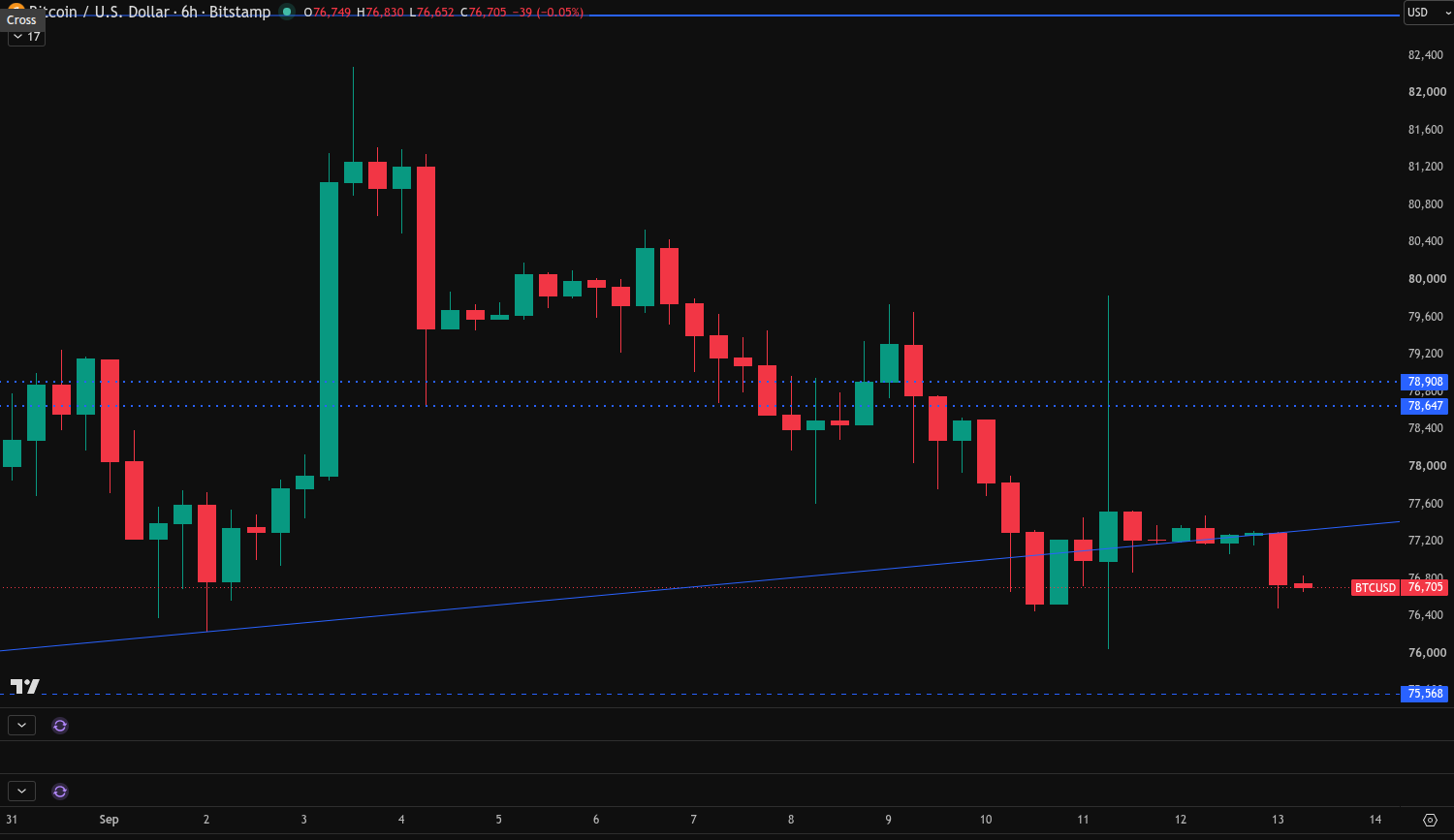
Bitcoin established range-bound behavior defined by overhead friction and structural support.
Why it matters: Technical rejection dictates market trajectory. The inability to break resistance forces sellers to test lower support boundaries.
By the numbers:
Trading Range: Prices operated within a $76,000 to $80,500 corridor.
Moving Averages: Spot valuations failed to reclaim the 50-week simple moving average at $79,668. Price traded $2,300 to $2,700 below this technical benchmark.
Supply Distribution: On-chain metrics track a distribution zone between $77,100 and $80,200. Long-term holders distributed 539,000 Bitcoin within this range over the past 30 days.
Bull Confirmation Line: The 365-day simple moving average sits at $81,700. A daily close above this line confirms broader market strength.
Support Levels: Immediate protection exists at $76,000. Deeper support rests at the $70,000 200-day moving average.
Between the lines: The week began with a Labor Day holiday squeeze toward $80,500. Sellers rejected this advance. The release of Producer Price Index data pushed prices down to $76,650. The Consumer Price Index release triggered a drop to $76,000. Buyers absorbed the supply at this floor, executing a short squeeze back toward $80,000 before settling near $77,320. The market remains in a distribution phase.
Corporate Treasury Divergence
Corporate entities executed divergent capital allocation strategies. Some firms acquired Bitcoin during price dips. Other operations prioritized balance sheet restructuring and output liquidation.
By the numbers:
Strive Acquisitions: Strive purchased 1,375 Bitcoin for $109 million. The average purchase price reached $79,281 per coin. Total holdings equal 24,531 Bitcoin.
Capital B Purchases: The French firm bought 376 Bitcoin for 25.3 million euros. The average cost was 67,182 euros per coin. Total holdings equal 3,521 Bitcoin.
MicroStrategy Pause: MicroStrategy paused Bitcoin acquisitions. The firm used $176.3 million of cash to retire 1,810,885 shares of STRC preferred stock at $97.36. The board raised the share repurchase limit to $2.0 billion.
Bitdeer Liquidation: The mining firm executed a complete liquidation of its weekly output. Bitdeer produced and sold 293.2 Bitcoin, valued at 22.6 million dollars, adding zero coins to corporate treasury.
Between the lines: Direct conversion of compute output to cash by miners introduces structural selling. If competing operators follow the Bitdeer liquidation policy, order books face persistent supply. MicroStrategy’s pivot to equity retirement demonstrates a focus on capital structure efficiency over absolute Bitcoin accumulation at current valuations.
Infrastructure, Security, and Regulation
The industry faced two distinct security incidents. Traditional financial integration advanced through regulatory filings.
Liquid Network Reserve Drain: An attacker extracted 4,000 Bitcoin from the Liquid Network federation wallet. The attack exploited an Elements range-proof cache bug during a SideSwap peg-out transaction. Reserves fell from 4,200 Bitcoin to 197 Bitcoin. The attacker returned 3,400 Bitcoin on Monday. A deficit of 608 Bitcoin remains. Blockstream states the federation will maintain a one-to-one peg. The Bitcoin base layer was not compromised.
Revolut Data Breach: An unauthorized actor accessed sensitive customer data at Revolut. The attacker used a spoofed government domain. The request passed SPF, DKIM, and DMARC authentication protocols. Exposed records include passport scans, home addresses, IBAN numbers, and complete Bitcoin transaction histories. Customer funds and exchange solvency remain secure.
Block Banking Charter: Block filed an application with the Office of the Comptroller of the Currency. The company seeks to charter Builders Bank and Trust, National Association. The entity will operate as an uninsured national trust bank. It will focus on custody and fiduciary services for Bitcoin and stablecoins, excluding consumer lending and deposit accounts.
Between the lines: The Liquid Network failure isolates risk to sidechain mechanics. Bridge connections remain a vulnerability. The Revolut incident highlights the threat of social engineering against high-net-worth individuals. Block’s charter application seeks to unify state-level trust licenses under a single federal supervisor. This represents an effort to secure direct access to federal banking infrastructure without operating as a traditional depository institution.
Forward Outlook
Market direction depends on legislative action and central bank policy decisions in the upcoming week. Regulatory progress and monetary policy could dictate capital flows. Bitcoin remains sensitive to the macroeconomic discount rate.
September 15: The United States Senate holds a cloture vote on the CLARITY Act (H.R. 3633) at 14:15 Eastern Time. The motion requires 60 votes to proceed to debate.
September 16: The Federal Open Market Committee releases its interest rate decision at 14:00 Eastern Time. The release includes the Summary of Economic Projections and the dot plot.
Why it matters: A rate increase will validate the 10-year Treasury yield’s push toward 5.0 percent. This outcome will pressure the $76,000 support level. A pause in rate hikes removes immediate dollar demand and reduces overhead friction. Market participants must monitor spot ETF flows to verify if institutions resume accumulation following the $462.7 million drawdown, or if distribution continues.
Two big events back to back — Tuesday's Senate vote on the crypto bill, Wednesday's Fed rate call — and this digest lays out the numbers on both. Worth adding: the ethics deal behind that Senate vote covers the President's spouse, not his adult sons, who co-founded the family's crypto business. Does that gap change how you read Tuesday?