


Bitcoin spent the week caught in a tug-of-war between rising sovereign debt yields and persistent corporate and institutional accumulation. The asset demonstrated structural resilience by absorbing pressure from global conflict, a multi-decade peak in United States Treasury rates, and an exploit at a major Asian trading venue. While surging oil prices and resilient consumer spending elevated borrowing costs, cooling labor data at the end of the week shifted Federal Reserve interest rate projections and provided a floor for risk assets. Beneath the macroeconomic volatility, fundamental adoption advanced. Spot exchange-traded funds registered massive net inflows before a mid-week reset, and corporate treasuries removed thousands of Bitcoin from open circulation. Traditional financial institutions deepened their integration with digital asset rails, clearing regulatory hurdles and expanding merchant settlement options. The week concluded with Bitcoin maintaining critical technical support, leaving investors to monitor whether economic softening can overcome the barrier of elevated bond yields.
Price Analysis
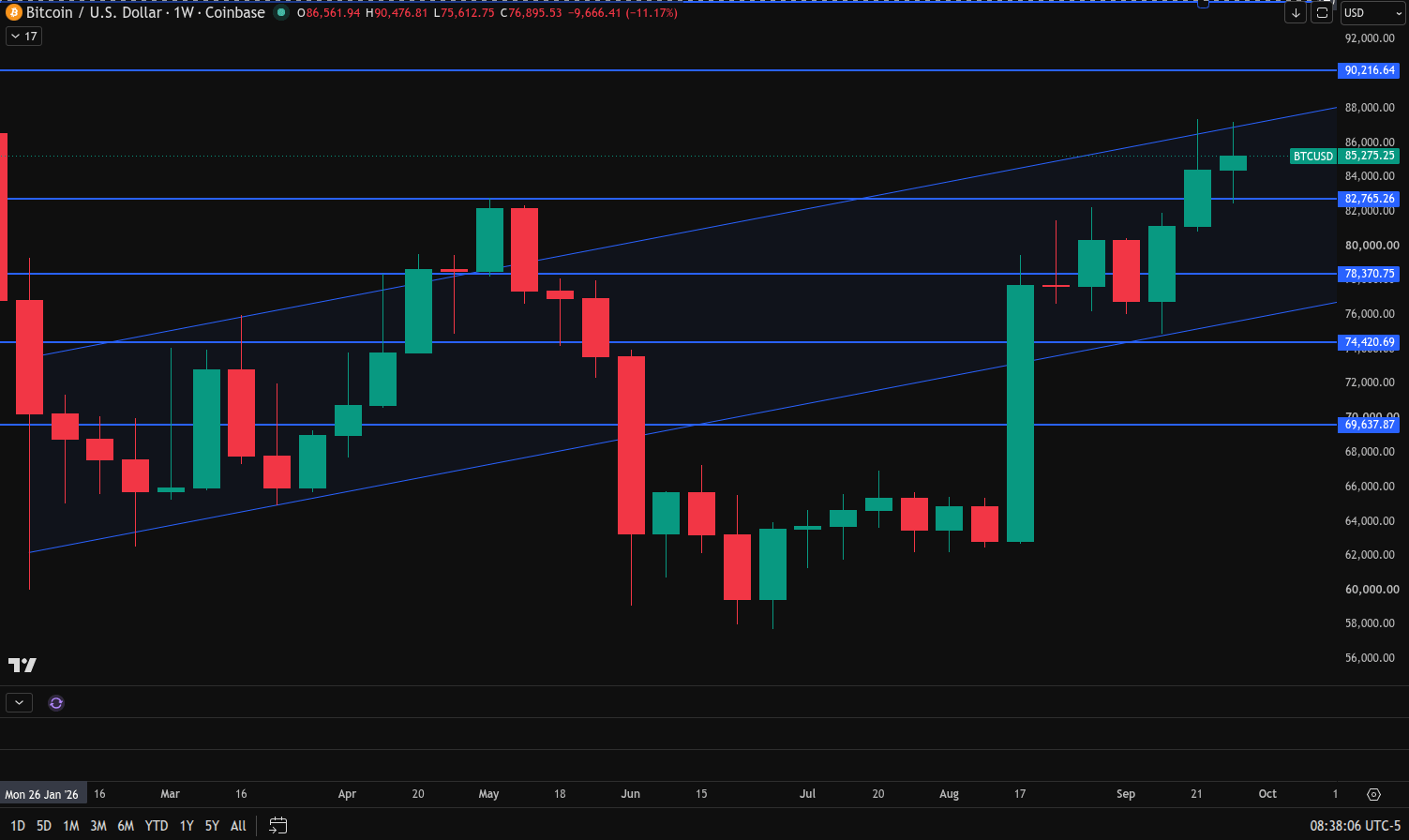
Spot market momentum tested multiple resistance levels across the seven-day trading period before settling into a weekend consolidation band. Bitcoin secured an eight-month weekend candle close of $84,467 on September 27. Sellers pushed the asset to a session low of $82,560 during the Monday transition, reacting to crude oil price advances. Buyers defended the $82,000 support level, lifting prices toward $84,450 by Tuesday. Wednesday featured a push toward $85,500 after the release of government inflation data. Exchange order books revealed a massive block of limit sell orders between $85,000 and $85,500 on the Binance platform. This sell block appeared on September 24 and tripled in volume across seven days. The resulting rejection dropped valuations to the $83,000 zone.
Price action surged during the Thursday night session and into Friday morning, breaking the $86,000 barrier to reach $86,885 on CoinDesk Data. A soft September employment report fueled an extension to a session peak of $87,219. Spot buyers failed to defend this breakout, triggering a massive derivatives liquidation event. CoinGlass data recorded a $433.57 million wipeout across twenty-four hours. Long positions absorbed the bulk of this flush, accounting for $321.77 million or 74.2% of the total. Short liquidations totaled $111.80 million. The liquidation wave returned the asset to a low of $83,860 on Friday afternoon. Weekend trading delivered a narrow price path, with buyers grinding the asset past the $85,000 level by Sunday morning. Spot prices sit near $85,300 at the end of the rolling window.
Macroeconomic Environment: Treasury Yields Challenge Risk Assets
Bond market dynamics dictated digital asset valuations throughout the week as United States Treasury yields reached multi-decade peaks. Geopolitical friction elevated energy markets, with Brent crude oil advancing 3.2% to cross the $100 per barrel mark. Iranian Foreign Minister Abbas Araghchi proposed terms to reopen the Strait of Hormuz, demanding the cessation of the United States naval blockade, complete waivers on oil sanctions, the release of frozen funds, and a permanent ceasefire in Lebanon. President Donald Trump dismissed these terms and refused to eliminate the possibility of military strikes before the November 3 midterms. Traders connected this crude oil pricing to inflation concerns.
This geopolitical tension exerted pressure across asset classes. Gold prices retreated 3.3% to $4,144, Nasdaq 100 futures lost 0.95%, and the US Dollar Index climbed to 101.09. The 10-year Treasury yield surged to 5.27% by Tuesday and continued climbing. During Thursday sessions, the 10-year yield touched 5.342%, representing the highest mark since April 2002. The 30-year Treasury yield reached a matching multi-decade high of 5.63%. The 2-year yield rose 5 basis points to 4.83%. Timothy Chubb of Girard noted the employment print leaves the Federal Reserve policy story unchanged.
The United States Treasury Department continued to execute debt management operations at authorized volume limits. Despite the $6 trillion in buybacks this week, elevated borrowing costs remained high. The US Dollar Index advanced past 102 to set an 18-month high. European sovereign spreads widened, pushing the French yield premium over German debt to a 14-year maximum. High sovereign bond yields elevate the discount rate on non-yielding assets, creating a structural headwind for Bitcoin.
Labor Market and Monetary Policy: Cooling Indicators Shift Rate Expectations
Economic data releases painted a picture of softening labor demand and consumer sentiment, altering Federal Reserve interest rate projections. The Bureau of Labor Statistics reported August job openings of 7.079 million, trailing the 7.23 million forecast and representing a drop from the revised July print of 7.335 million. The job openings rate fell to 4.3%, marking the lowest level since March. The release recorded 5.192 million hires, 3.066 million quits for a 1.9% rate, and 1.6 million layoffs. The Conference Board Consumer Confidence Index fell to 81.9 in September, missing consensus estimates of 89. The present situation index fell to 109.3, and expectations dropped to 63.6. Chief Economist Dana Peterson noted current business appraisals shifted to negative territory for the first time since September 2024. Survey respondents marking jobs as difficult to get rose to 21.9%.
The employment situation deteriorated with the Friday nonfarm payrolls report. The United States economy added a mere 29,000 jobs in September, falling short of the 90,000 to 98,000 consensus expectation and trailing the twelve-month average of 45,000. The Bureau of Labor Statistics lowered prior counts by 60,000 positions across July and August. Unemployment rose to 4.2%. Average earnings per hour rose 5 cents to $37.81, below the 0.3% forecast, placing annual wage growth at 3.0%. Health care led additions with 17,000 jobs, construction added 11,000, manufacturing gained 9,000, and financial activities dropped 7,000.
Federal Reserve communication aligned with these cooling indicators. Federal Reserve Bank of New York President John Williams stated the September rate increase eliminated the need for urgency. Williams projected 2026 inflation of 3.5%, inflation above 2% in 2027, and a return to 2% in 2028. August Personal Consumption Expenditures data showed current-dollar PCE expanding by $190.8 billion, a 0.9% gain, while real PCE rose 0.6%. Headline inflation rose 0.3% month-over-month and 3.4% year-over-year. Core inflation rose 0.2% month-over-month and 3.0% year-over-year. Market models responded to the combination of soft labor numbers and controlled inflation. CME FedWatch metrics showed the probability of an October rate hike dropping from 71% to 17% following the Friday employment print. Prediction market Kalshi recorded October hike odds falling to 18%.
Institutional Fund Flows: Streak Ends Before Buyers Return
Institutional capital allocations to United States spot Bitcoin exchange-traded funds exhibited high volatility across the trading week. The week commenced with an eighth consecutive session of net cash additions on Monday, as spot funds accumulated $31.1 million. The BlackRock iShares Bitcoin Trust (IBIT) led the market with $54.8 million in net purchases, while the ProShares Bitcoin ETF added $10.3 million. Tuesday delivered a ninth consecutive inflow day, generating $66.2 million in net additions. The BlackRock IBIT fund captured $51.1 million, and the Ark 21Shares ARKB fund registered $33.2 million. Cumulative net inflows across the sector passed the $57.6 billion mark.
This momentum fractured on Wednesday. The spot funds snapped the nine-day inflow run with net redemptions of $148.7 million. The Fidelity FBTC product recorded an outflow of $125.6 million. The BlackRock IBIT fund ended a personal nine-day accumulation run with $9.5 million in redemptions. The Bitwise BITB fund posted redemptions of $13.6 million. Zero funds recorded net inflows during the Wednesday session. Spot Ether exchange-traded funds shared this pressure, experiencing five-day net outflows of $118.0 million.
Institutional buyers returned on Thursday, reversing the Wednesday redemptions with $103 million in aggregate net purchases. The BlackRock IBIT product drew $195.6 million. The Grayscale Bitcoin Mini Trust added $14.6 million, and MSBT recorded $7 million. These additions offset an outflow of $60.7 million from the Fidelity FBTC fund, $31.4 million from Grayscale GBTC, and $7.7 million from ARKB. Friday registered an inflow of $31.7 million, excluding pending data from BlackRock. The Fidelity FBTC fund gained $29.3 million on Friday, but concluded the five-day period with a net deficit of $167.9 million. The provisional five-day net inflow stands at $82.9 million, contrasting with the prior week intake of $2.39 billion. Total ETF net assets hold at $109.3 billion, equal to 6.43% of the total Bitcoin market capitalization.
Corporate Treasury Operations: Strategy and Strive Expand Holdings
Public companies expanded Bitcoin balance sheet programs, withdrawing circulating supply from open markets. Strategy filed an SEC Form 8-K detailing the acquisition of 1,665 Bitcoin between September 21 and September 27. The enterprise deployed $142.7 million from common stock sales to fund the transaction. The purchase averaged $85,706 per coin, pushing total company holdings to 847,666 Bitcoin. The aggregate cost basis for this massive reserve sits at $63.95 billion, representing an average cost of $75,437 per coin. Net proceeds from common stock sales under an At-The-Market facility generated $246.2 million. Strategy directed $103.5 million from share sales and $48.1 million from company USD Cash reserves to retire 1,534,530 STRC preferred shares for $151.7 million. The corporation retains a $5.02 billion USD Reserve and $1.00 billion in cash following preferred dividend distributions of $22.1 million.
Asset manager Strive filed a separate Form 8-K documenting the purchase of 1,107 Bitcoin. The firm executed the transaction between September 21 and September 25 at an average price of $85,396 per coin. Strive expanded its corporate treasury from 26,355 Bitcoin to 27,462 Bitcoin. The purchases utilized equity capital, allowing cash and cash equivalents to rise from $229.6 million to $248.8 million. Class A common shares expanded by 649,072 to 88,453,685 shares, and SATA preferred shares expanded by 1,009,020 to 12,193,180 shares. Strive maintains ownership of 505,000 shares of Strategy STRC preferred stock, representing a market valuation of $49.8 million.
Equity analysts rewarded these corporate allocation strategies with upgraded valuation models. Citigroup raised its equity price target for Strategy shares to $240 from $136 while maintaining a Buy rating. The $240 target represents a 50% premium above the October 1 closing price of $160.50. Citigroup raised the valuation multiple for Strategy to 4.0x Bitcoin yield, an increase from a previous 2.5x multiple. The bank noted the implied modified net asset value rose to 1.24x, compared to a prior 1.065x. The research note accompanied a revised 12-month Bitcoin price projection of $113,000, up from an $82,000 forecast, accounting for 34% of the target increase. Citigroup forecasts $5 billion in net ETF inflows over the coming twelve months from expanding wealth management allocations.
Regulatory Developments: SEC Transitions and Policy Frameworks
The regulatory environment experienced structural changes and policy announcements. Hester Peirce concluded her tenure as a Commissioner at the Securities and Exchange Commission on October 2. She described her departure to The Banker as an expected and healthy event. Her exit reduces the Commission to two sitting members, Chairman Paul Atkins and Commissioner Mark Uyeda. The administration named no successor for the vacant seat. The two-member Commission creates operational fragility for future rulemaking, as a single recusal or absence leaves the agency without the capacity to execute formal votes.
The Securities and Exchange Commission introduced proposed custody guidelines for investment advisers and regulated funds. The proposal permits registered investment advisers to self-custody crypto assets in the absence of a qualified custodian. Compliance standards require advisers to conduct quarterly custodian availability evaluations, enforce dual approvals, segregate assets, maintain cybersecurity controls, and submit annual accountant internal-control audits. The framework also expands qualified custodian eligibility to state trust companies under specific verification parameters. The package modernizes broker-dealer fund custody and exempts discretionary trading from standard custody constraints. SEC Chair Paul Atkins noted rules failed to keep pace with a multitrillion-dollar market. The proposal enters a 60-day public comment window upon Federal Register publication.
The Commodity Futures Trading Commission granted a Derivatives Clearing Organization license to Coinbase Clearing. This approval finalizes domestic futures architecture for the exchange, combining a Futures Commission Merchant, a Designated Contract Market, and a clearinghouse. General Counsel Molly Abraham confirmed the license completes the derivatives structure for the company. The order restricts operations to contracts backed by 100% collateral utilizing USDC for continuous 24-hour settlement. Margined products and planned equity perpetual contracts will continue through third-party clearing firms.
Exchange Security and Infrastructure: Bitget Rebuilds Buffer
Asian trading venue Bitget restored customer Bitcoin withdrawal services on schedule after an infrastructure breach. The exchange processed 3,609 Bitcoin from 7,683 withdrawal applications during the initial hours of service restoration. Confirmed on-chain transactions reached 6,946 applications with zero order backlog on the Bitcoin network. The platform patched the software vulnerability and detected zero additional unauthorized asset transfers. Withdrawal access expanded across Ethereum networks on September 29 and Tether networks on September 30.
Bitget regional head Xie Jiayin stated the company refilled a user protection fund to a balance of 3,705 Bitcoin. The executive valued this reserve at $316 million, declaring the fund utilizes company capital instead of client assets. Xie reported proof of reserves on 19 mainstream assets sits at 131%. Trading and asset clients can share 30% of Bitget revenue, excluding the institutional book, for four weeks. The stated buffer remains smaller than the $387.5 million loss recorded on September 25. The platform published zero auditor documentation or blockchain explorer verification links to confirm the refill. If a future reserve file shows the 3,705 Bitcoin moving out of the protection fund, or if Bitcoin withdrawals experience another suspension, market participants will view the reserve as an unfinished hole instead of a secure buffer.
Geopolitics and Compliance: Scrutiny on Tether Networks
Geopolitical friction prompted legislative inquiries into stablecoin payment rails. Senate Permanent Subcommittee on Investigations staff published an analysis of 846 digital asset addresses under sanctions for links to Iran. The report stated 84% of these addresses utilized USDT for transactions. USDT represented 87% of 757 Israel-designated addresses and 57% of 101 Office of Foreign Assets Control addresses, capturing over 80% of dollar settlement volume across the analyzed networks. The documentation highlighted transactions exceeding $603 million in USDT by two sanctioned oil-smuggling networks.
Senator Richard Blumenthal labeled USDT a financial bridge for Iranian operations and demanded responses from Treasury Secretary Scott Bessent and Deputy Attorney General Todd Blanche regarding compliance oversight. Tether representatives cited cooperation with global law enforcement agencies and documented the freezing of $550 million in Iran-linked assets during 2026. Blockchain analytics firm TRM Labs reported USDT volume tied to Iran dropped to 14% in August 2026 from 67% in 2025 following asset freezes initiated in April. Market observers view the inquiry as an administrative focus on dollar stablecoin compliance. The failed Senate cloture vote on the CLARITY Act on September 16 preserves stablecoin yield programs under the GENIUS framework for platforms including Coinbase. Bitwise Chief Investment Officer Matt Hougan noted the legislative delay prevented a national licensing system that would ease market entry for rivals.
Retail Trading and Banking Integration: Expanded Access
Traditional banking institutions and retail brokerage platforms expanded digital asset integrations. Citigroup launched a commercial agreement with Coinbase to enable merchant stablecoin settlements on the Spring by Citi platform. The integration permits business customers to accept stablecoin payments at checkout. The customer tokens convert into sovereign fiat currency, utilizing Citigroup as the bank of record for transactions. Coinbase Virtual Accounts operate on the Citigroup Virtual Account Wallet architecture, allowing business customers to convert incoming fiat into stablecoins with a 3.75% annual percentage yield reward. Citigroup Services head Shahmir Khaliq stated the system connects Citigroup settlement infrastructure, which processes $6 trillion per day, to 150 million stablecoin holders.
Robinhood unveiled plans to launch United States perpetual futures contracts for retail clients. Chief Executive Officer Vlad Tenev announced the product at the HOOD Summit, detailing a rollout through Robinhood Derivatives. The roadmap includes contracts for Bitcoin, Ethereum, Solana, XRP, Dogecoin, Cardano, Chainlink, and Hyperliquid. The platform caps leverage at 10x for Bitcoin and Ethereum, featuring continuous trading and settlement every 15 minutes. Robinhood set a promotional trading fee of 1 basis point through year-end, below the 2 basis points standard on Coinbase. The product lacks FDIC or SIPC coverage but incorporates risk alerts and stop-loss orders.
Corporate equity listings returned to focus as Blockchain.com Group Holdings prepared a public stock offering. The firm intends to raise $500 million during 2026, targeting a valuation between $4 billion and $6 billion. The company filed a confidential Form S-1 registration statement in May, demonstrating three consecutive years of positive adjusted profit. The proposed valuation represents a 57% to 71% discount from the $14 billion valuation benchmark set in 2022. Payward is taking steps to pursue an equity market listing.
Mining Fundamentals: Hashrate Reaches Multi-Month High
Network computation power recovered from a prolonged capitulation phase. The 30-day average hashrate reached 944.6 exahashes per second on October 1, marking the highest level since June 13. Charles Edwards of Capriole identified the first network growth since 2025 following miner capitulation. This metric remains 15% below the November 2025 peak following a previous 19% drawdown. Network difficulty adjusted at block 969,696 on October 3, at 07:16 UTC, to 132.72 trillion, a 0.03% decline from 132.76 trillion. Dashboards had been pointing to another increase after the September 19 rise of 4.16%; block times instead finished the epoch essentially on the 10-minute target, so the expected tightening did not arrive..
The price advance past $86,000 returned Bitcoin above the JPMorgan production cost estimate of $85,000. Mining corporations continue diversifying revenue streams, with Core Scientific drawing 83% of second-quarter revenue from colocation and TeraWulf generating 71% from high-performance computing leases.
Derivatives open interest underwent a massive reset. Coin-denominated futures open interest dropped to 628,000 BTC on Tuesday, establishing a year-to-date low and matching levels from March. K33 Research documented a drop of 49,000 BTC across combined CME and perpetual futures open interest in a seven-day period. The CME September contract expiration removed 16,075 BTC from the board, representing 15.79% of open interest. Market liquidations remained minor at $51 million to $68 million during this reset. K33 analyst Vetle Lunde characterized the activity as profit realization, avoiding forced selling. Glassnode observed that Bitcoin gained 35% from the August low while coin-denominated open interest declined 20% over the identical timeframe.
Looking Ahead: Upcoming Market Milestones
Monday, October 5 (10:00 ET): The Institute for Supply Management releases the ISM Services index, providing the first major United States economic data print of the week.
Wednesday, October 7 (14:00 ET): The Federal Open Market Committee publishes the minutes from its September 17 meeting, offering deeper context into the recent policy rate increase to the 3.75% to 4.00% range.
Wednesday, October 28: The Federal Open Market Committee issues its next interest rate decision, forcing macro markets to weigh the recent September payroll miss against elevated Treasury yields.
Pending — SEC Nominations: Market observers await White House nomination announcements to fill the three open seats at the Securities and Exchange Commission following Commissioner Hester Peirce’s exit.